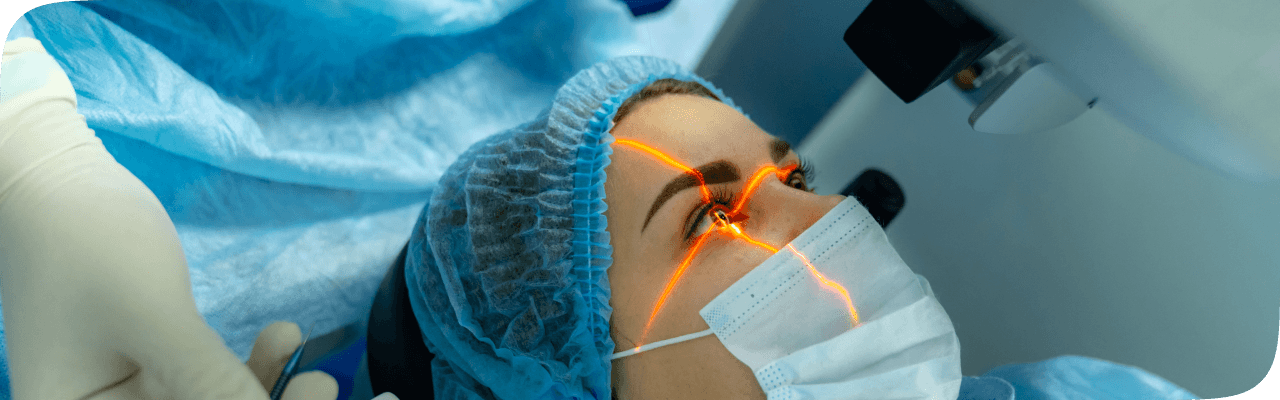
YAG laser capsulotomy is a simple outpatient laser procedure used to restore vision that has become cloudy following cataract surgery.
After cataract surgery, some patients develop a condition called posterior capsule opacification (PCO), where the membrane supporting the artificial lens becomes cloudy. YAG laser treatment safely clears this clouding and restores visual clarity.
Book a consultation today to find out if YAG laser treatment is right for you.
Following cataract surgery, the artificial lens implant is placed inside the natural lens capsule, which helps support the new lens.
In some patients, this capsule may become cloudy months or even years after surgery. This is known as posterior capsule opacification (PCO) and can cause symptoms similar to cataracts, including blurred or hazy vision.
YAG laser capsulotomy is a quick, painless laser treatment that creates a small opening in the cloudy capsule, allowing light to pass through clearly again.
Treatment is only recommended when the capsule clouding begins to affect vision or daily activities.

- YAG laser capsulotomy is a quick outpatient laser procedure used to restore vision after cataract surgery.
- After cataract surgery, the artificial lens sits inside the natural lens capsule, which is left in place to support it.
- In some patients, this capsule later becomes cloudy, causing the vision to become blurred again.
- This clouding is known as posterior capsule opacification, or PCO.
- YAG laser treatment creates a small opening in the cloudy capsule so that light can once again pass through clearly.
- The underlying cause of needing YAG laser treatment is posterior capsule opacification after cataract surgery.
- This happens when cells remaining in the lens capsule multiply and cause the capsule to become cloudy.
- PCO can develop months or even years after an otherwise successful cataract operation.
- It is not a new cataract, but rather a common after-effect of cataract surgery in some patients.
- Not every patient develops significant capsule clouding, and treatment is only needed if vision is affected.
- The most common symptom is blurred or hazy vision after vision had previously improved following cataract surgery.
- Some patients notice increased glare or dazzling from bright lights.
- Vision may begin to feel similar to how it was before the cataract was removed.
- Daily activities such as reading, driving, or watching television may become more difficult again.
- In some cases, patients feel that their visual clarity has gradually reduced without pain or redness.
- The treatment is YAG laser capsulotomy, which is performed in clinic without any cuts or stitches.
- Drops are used to dilate the eye and numb the surface before the laser is carried out.
- The procedure usually takes around 10 to 15 minutes and is generally painless.
- Many patients notice an improvement in vision soon after treatment, although mild dazzling can occur temporarily.
- Some people notice floaters for a short time afterwards, but most can return to normal activities the same day apart from driving.
Don’t wait. Take the first step towards life-changing results by scheduling your personal consultation today.
Q. What is an Ophthalmologist?
An Ophthalmologist is a medical doctor specialising in eye and vision care. They have trained specifically in various aspects of eye disease and ophthalmic surgery.
Q. How much does it cost to see an Ophthalmologist privately?
An Ophthalmologist is a medical doctor specialising in eye and vision care. They have trained specifically in various aspects of eye disease and ophthalmic surgery.
Q. How long is the average wait time to see our Ophthalmologist?
An Ophthalmologist is a medical doctor specialising in eye and vision care. They have trained specifically in various aspects of eye disease and ophthalmic surgery.
BOOK AN APPOINMENT