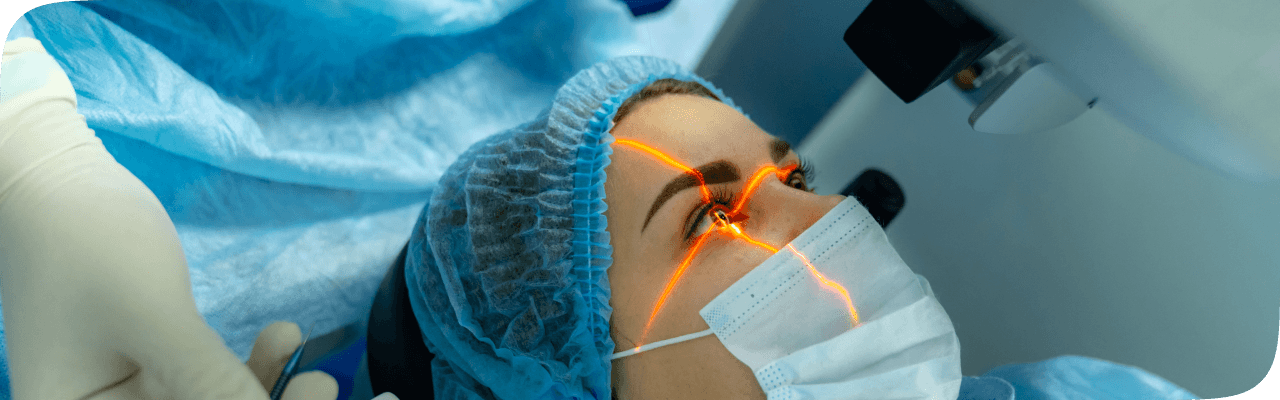
Squint (strabismus) and double vision (diplopia) are conditions that affect how the eyes work together. These conditions may cause eye misalignment, visual discomfort, or seeing two images instead of one.
Our specialist consultants and orthoptists provide detailed assessment, monitoring, and personalised treatment plans to improve eye alignment and visual comfort.
Book a consultation for a comprehensive eye alignment assessment.
Squint and double vision can occur in both children and adults and may develop gradually or suddenly depending on the cause.
These conditions may affect vision, depth perception, and confidence, particularly if eye misalignment becomes noticeable.
At our clinic, careful assessment allows us to determine the cause, monitor changes, and recommend the most appropriate treatment.
In many cases, non-surgical treatments may successfully control symptoms.

- Squint, also known as strabismus, is a condition where the eyes are not properly aligned and do not point in the same direction.
- Double vision, also known as diplopia, occurs when the eyes are not working together accurately and a person sees two images instead of one.
- These problems can occur separately or together, depending on the underlying cause.
- They may affect children or adults and can range from mild and occasional to more constant and troublesome.
- Careful assessment is needed to understand how the eyes are moving and whether treatment is required.
- Squint and double vision can be caused by imbalance in the eye muscles that control eye position.
- They may also result from problems affecting the nerves that supply those muscles.
- In some patients, the condition is related to childhood eye misalignment that has persisted or returned in later life.
- Double vision can also occur after illness, injury, or neurological conditions affecting coordination of eye movements.
- Occasionally, vision problems or differences in focus between the two eyes can contribute to poor alignment.
- The most obvious symptom of squint is that one eye may appear to turn in, out, up, or down.
- Double vision causes a person to see two images of a single object, which can be very disturbing or disorientating.
- Some patients experience eye strain, tiredness, or discomfort when trying to focus.
- Depth perception may be affected, making daily tasks more difficult.
- In adults, symptoms may worsen when tired or when looking in certain directions.
- Treatment depends on the cause and severity of the problem and begins with a full orthoptic and consultant assessment.
- Some patients can be helped with glasses, prisms, or eye exercises without needing surgery.
- Monitoring may be recommended if the condition is mild or stable over time.
- If surgery is needed, it involves adjusting the position or strength of the eye muscles to improve alignment.
- Surgical treatment can reduce double vision, improve eye position, and increase comfort and confidence.
Don’t wait. Take the first step towards life-changing results by scheduling your personal consultation today.
Q. What is an Ophthalmologist?
An Ophthalmologist is a medical doctor specialising in eye and vision care. They have trained specifically in various aspects of eye disease and ophthalmic surgery.
Q. How much does it cost to see an Ophthalmologist privately?
An Ophthalmologist is a medical doctor specialising in eye and vision care. They have trained specifically in various aspects of eye disease and ophthalmic surgery.
Q. How long is the average wait time to see our Ophthalmologist?
An Ophthalmologist is a medical doctor specialising in eye and vision care. They have trained specifically in various aspects of eye disease and ophthalmic surgery.
BOOK AN APPOINMENT