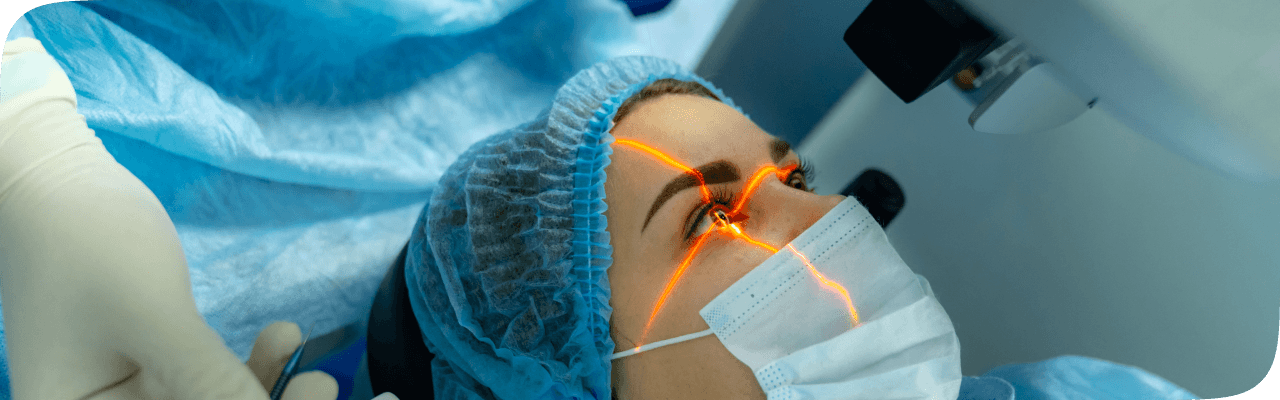
Retinal Laser
Specialist Laser Treatment to Protect and Stabilise Retinal Health

Retinal laser treatment is used to treat or stabilise a range of conditions affecting the retina, the light-sensitive layer at the back of the eye that is essential for vision.

Our retinal specialists use advanced diagnostic imaging and laser technology to protect vision and prevent further retinal damage when necessary.

Book a consultation today for a comprehensive retinal assessment.

Overview

Retinal laser treatment is commonly used to manage conditions such as retinal tears, diabetic eye disease, and areas of reduced blood circulation within the retina.

During routine monitoring visits, your consultant will carefully examine the retina using specialised imaging and clinical examination techniques. This helps determine whether treatment is required or whether the condition can safely be monitored.

In some cases, regular observation may be recommended if the retina appears stable and the risk of progression is low.

Definition
What Is a Retinal Laser?
  • Retinal laser treatment is a procedure used to treat or stabilise certain conditions affecting the retina at the back of the eye.

  • The retina is the light-sensitive layer that plays a vital role in vision, so protecting it is important.

  • Laser treatment can be used to strengthen weak areas, seal tears, or reduce abnormal retinal changes.

  • It is commonly used as part of the management of retinal tears, diabetic eye disease, and other retinal problems.

  • The procedure is usually performed in clinic and does not normally require a general anaesthetic.
Causes
Causes of a Retinal Laser
  • Retinal laser may be needed when there is a retinal tear that could lead to a retinal detachment if left untreated.

  • It is also used in diabetic eye disease when abnormal blood vessels or leakage threaten vision.

  • Areas of poor retinal circulation can sometimes require laser treatment to reduce the risk of further damage.

  • In some patients, the retina develops weak or abnormal areas that need strengthening to protect sight.

  • The decision to perform laser treatment is based on examination findings and retinal imaging rather than symptoms alone.
Symptoms
Symptoms of a Retinal Laser
  • Some retinal conditions treated with laser cause flashes of light or new floaters in the vision.

  • Other patients notice blurred vision or patches of reduced vision depending on the location of the retinal problem.

  • Diabetic retinal disease may not cause symptoms at first, even when treatment is needed.

  • A retinal tear can sometimes produce sudden visual symptoms that require urgent assessment.

  • In certain cases, the condition is found during routine monitoring before the patient notices any obvious change.
Treatment
Treatments for a Retinal Laser
  • Retinal laser treatment is performed using anaesthetic drops to keep the eye comfortable during the procedure.

  • The laser works by sealing, strengthening, or reducing abnormal areas of the retina to help protect vision.

  • Treatment is usually quick and is carried out as an outpatient procedure.

  • Some patients only require monitoring if the retinal condition is stable and does not yet need laser intervention.

  • After treatment, vision may be slightly blurred for a short time, but most patients can return to normal activities soon afterwards.
Your Journey to Better Vision Starts Here

Don’t wait. Take the first step towards life-changing results by scheduling your personal consultation today.

Frequently Asked Questions
Q. What is an Ophthalmologist?

An Ophthalmologist is a medical doctor specialising in eye and vision care. They have trained specifically in various aspects of eye disease and ophthalmic surgery.

An Ophthalmologist is a medical doctor specialising in eye and vision care. They have trained specifically in various aspects of eye disease and ophthalmic surgery.

An Ophthalmologist is a medical doctor specialising in eye and vision care. They have trained specifically in various aspects of eye disease and ophthalmic surgery.