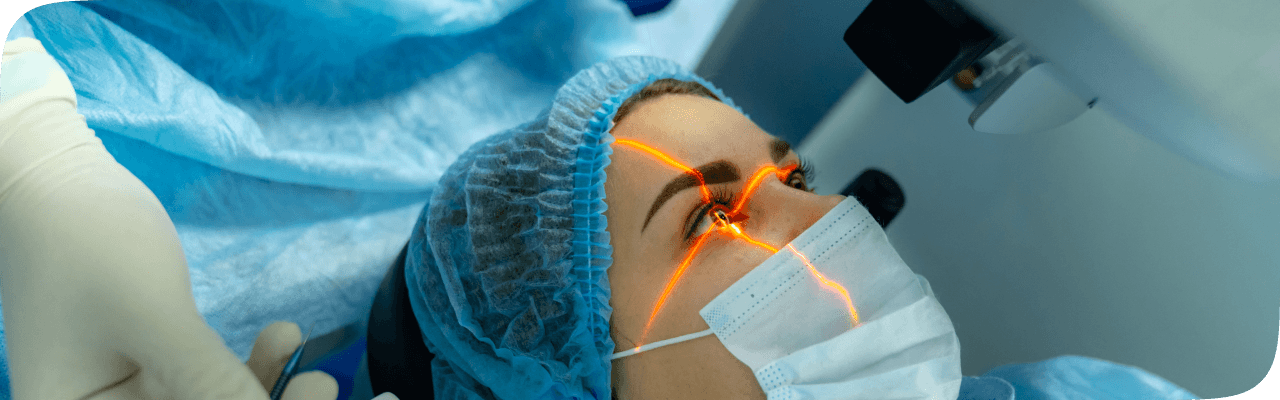
Laser Eye Surgery
Advanced Laser Vision Correction to Reduce Dependence on Glasses and Contact Lenses

Laser eye surgery (refractive surgery) is designed to correct common vision problems such as short-sightedness, long-sightedness, and astigmatism. The goal is to improve vision and reduce reliance on glasses or contact lenses.

Our experienced refractive surgeons use advanced diagnostic technology and modern laser techniques to deliver safe, precise, and personalised treatment.

Book a consultation to find out if laser vision correction is suitable for you.

Overview

Laser eye surgery works by reshaping the cornea (the clear front surface of the eye) to improve how light focuses on the retina.

This treatment may help patients who:

• Are dependent on glasses
• Use contact lenses regularly
• Have stable vision prescriptions
• Want greater convenience in daily life


Careful assessment is essential to determine whether laser eye surgery is safe and suitable for your eyes.

Definition
What Is a Laser Eye Surgery?
  • Laser eye surgery is a refractive procedure designed to reduce dependence on glasses or contact lenses.

  • It works by reshaping the cornea so that light focuses more accurately onto the retina.

  • The treatment is commonly used to correct short-sightedness, long-sightedness, and astigmatism.

  • It is an elective procedure, meaning patients choose it to improve convenience and visual freedom in daily life.

  • A detailed pre-treatment assessment is essential to confirm that the eyes are healthy and suitable for surgery.
Causes
Causes of a Laser Eye Surgery
  • People usually consider laser eye surgery because they have a refractive error such as myopia, hyperopia, or astigmatism.

  • These focusing problems occur when the eye shape causes light to focus incorrectly.

  • Some patients want treatment because they are dependent on glasses or contact lenses for everyday tasks.

  • Others seek laser eye surgery for lifestyle reasons, such as sport, work convenience, or comfort.

  • Suitability also depends on factors such as prescription stability, corneal thickness, tear film quality, and overall eye health.
Symptoms
Symptoms of a Laser Eye Surgery
  • The main issue leading patients to consider treatment is blurred vision without glasses or contact lenses.

  • Short-sighted patients may struggle to see clearly in the distance, while long-sighted patients may find near tasks difficult.

  • Astigmatism can cause distorted or blurred vision at multiple distances.

  • Some people experience inconvenience, discomfort, or dryness from wearing contact lenses regularly.

  • Others simply want greater freedom from glasses for work, travel, exercise, or daily life.
Treatment
Treatments for a Laser Eye Surgery
  • Treatment begins with a detailed consultation and assessment to decide whether laser eye surgery is safe and appropriate.

  • If suitable, numbing drops are used so the procedure is comfortable and does not require injections or general anaesthetic.

  • The laser reshapes the cornea using highly precise pulses of light to improve the focusing of the eye.

  • The procedure usually takes only a few minutes per eye, and vision often starts to improve within days.

  • Although results are often excellent, patients may still need glasses in some situations later in life, especially for reading.
Your Journey to Better Vision Starts Here

Don’t wait. Take the first step towards life-changing results by scheduling your personal consultation today.

Frequently Asked Questions
Q. What is an Ophthalmologist?

An Ophthalmologist is a medical doctor specialising in eye and vision care. They have trained specifically in various aspects of eye disease and ophthalmic surgery.

An Ophthalmologist is a medical doctor specialising in eye and vision care. They have trained specifically in various aspects of eye disease and ophthalmic surgery.

An Ophthalmologist is a medical doctor specialising in eye and vision care. They have trained specifically in various aspects of eye disease and ophthalmic surgery.